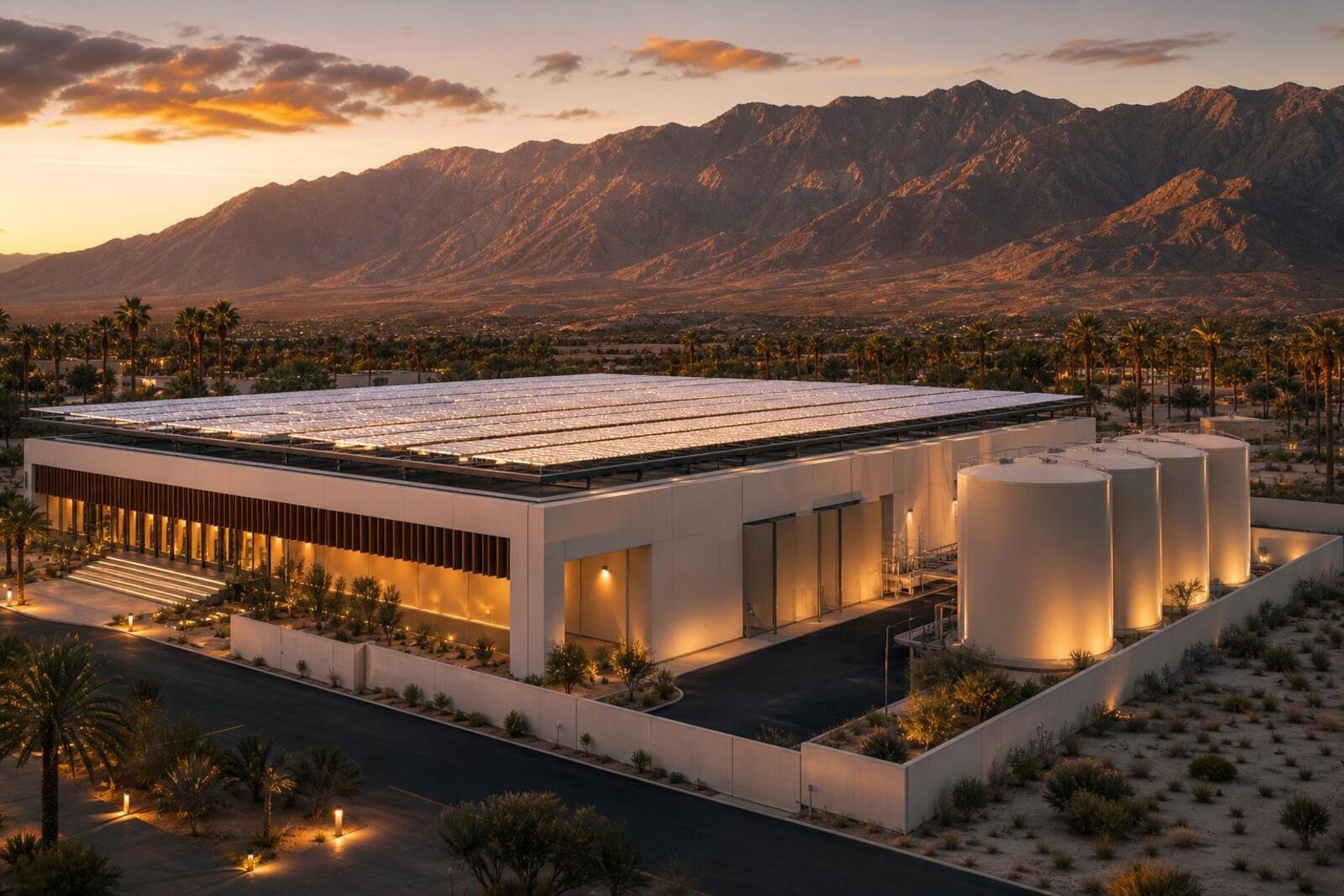
In brief: Most data centers still cool with evaporating water — and that water never comes back. As the Coachella Valley debates a 240-acre data center proposal, we argue the answer isn't "no data centers" or "business as usual." It's a third way: facilities that give back to the grid and take nothing from the aquifer.
The hidden water bill behind every click
Every search, stream, and AI query ends its journey in a building full of hot servers — and keeping those servers cool has quietly become one of the thirstiest jobs in modern infrastructure. Most large, modern data centers use water-based cooling, often cooling towers or evaporative chillers: warm water absorbs heat from the servers and is then cooled by evaporation. As the water turns to vapor, it carries the heat away — dramatically cutting the electricity needed for cooling. The trade-off is high water consumption.
And that water doesn't come back. Up to 85% of the water data centers use evaporates and never returns to the local supply. The scale is staggering: a 2024 report from Lawrence Berkeley National Laboratory estimated that U.S. data centers consumed 17 billion gallons of water directly for cooling in 2023 — and projects that figure could double, or even quadruple, by 2028. The AI boom is accelerating it: hyperscale AI facilities average roughly half a million gallons a day, and the largest consume up to 5 million gallons daily — on par with a small town.
Why this matters here, in our desert
The Coachella Valley knows water scarcity firsthand. We live inside a megadrought that, beginning in 2000, is the driest stretch in at least 1,200 years. Meanwhile, the digital economy is arriving at our doorstep — and our neighbors are rightly asking hard questions. A 240-acre proposal on the city of Coachella's agriculturally rich east side has drawn packed city-hall meetings and more than 100 residents protesting at Veterans Park. In early June, after months of public pressure, the City Council approved a 45-day moratorium on data centers and severed its agreement with the project's developer — a clear signal that the community won't accept business as usual.
Just over the ridge, the stakes are visible: in the Imperial Valley, one proposed 330-megawatt data center would require roughly 750,000 gallons of water a day — about 2.8 million liters — to keep its servers cool.
We believe the answer isn't to reject digital infrastructure. It's to demand better engineering — engineering that treats the desert's constraints as design inputs, not afterthoughts.
The desert's secret advantage: the sky itself
Here's what gets lost in the debate: the same climate that makes the Coachella Valley hard on cooling systems also makes it one of the best places in America for a different approach entirely.
Our valley has three things in abundance: intense sun, dry air, and — critically — clear night skies with huge day-to-night temperature swings. On a clear, dry night, any surface facing the sky radiates heat directly into cold outer space through what physicists call the "atmospheric window." It's why desert sand turns cold after sundown. This phenomenon — radiative sky cooling — is free, silent, uses zero water, and works best precisely where we live.
The PhaseSave approach: store cold, don't evaporate water
At PhaseSave, we're developing an integrated cooling architecture for desert data centers built on three layers — none of which consume a drop of water in operation:
- Harvest the night sky. Rooftop radiative panels reject heat to the sky around the clock, working hardest during our cool, dry desert nights — offsetting the compressors and cooling towers that conventional facilities rely on.
- Bank the cold in phase-change materials. Just as ice keeps a cooler cold all day, engineered phase-change materials (PCMs) freeze at night — when the sky is giving cooling away free and grid power is cheapest and cleanest — then melt through the brutal afternoon peak, releasing stored cooling exactly when the grid and the building need it most.
- Buffer heat at the source. Passive PCM modules inside the data hall absorb heat spikes directly at the server racks, smoothing demand on the central cooling plant and letting the whole system run smaller, steadier, and smarter.
The result: a data center that shifts its biggest electrical load off the 4–9 p.m. peak, sheds demand when the grid is stressed — and does it all with closed loops and zero evaporative water loss.
We're not alone in seeing this future. Zero-water design is becoming the industry's direction: Microsoft's next-generation data centers use a closed-loop, chip-level design that eliminates evaporative water entirely, avoiding more than 125 million liters of water per facility each year — with pilot sites already in Phoenix, Arizona and Mt. Pleasant, Wisconsin. Our contribution is making that future work at the scale of the facilities already in our valley — and turning cooling systems into grid assets that earn their keep.
Good for the grid. Good for the aquifer. Good for the valley.
A desert data center built this way isn't a burden on the community — it's a partner to it:
- Water: Zero evaporative consumption. Every acre-foot not evaporated by a cooling tower stays available for homes, farms, and the aquifer.
- Grid: Stored cooling means the facility can drop its demand during summer peak events — the exact hours when our grid strains hardest — and get paid for it through utility demand-response programs.
- Community: Quieter operation, less peak chiller runtime, and a replicable model that says to every future developer: this is the standard the desert expects.
What's next
PhaseSave is assembling partners for a pilot demonstration right here in the Palm Springs area — pairing our thermal storage and sky-cooling architecture with a working facility, utility demand-response programs, and California clean energy funding. If you operate a data center, telecom facility, or large cooling plant in the Coachella Valley — or you're a building owner who wants to help prove the desert can host the digital economy on its own terms — we'd like to talk.
The cloud is coming to the desert. Let's make sure it arrives without a straw in our water supply.
Partner with us on the pilot.
Let's prove the desert can host the digital economy — water-free, off-peak, grid-friendly.
Contact PhaseSavePhaseSave performance figures will be published as measured from our pilot demonstration.